ClariRec includes an on-device formula recognition engine (powered by GLM-OCR) — free for 20 recognitions each calendar month on eligible Macs, unlimited with Pro — that converts printed math equations from screenshots into clean LaTeX. It runs entirely on your Mac with zero network traffic, no API keys, and no recurring cloud costs.
This page covers setting up and using the local offline engine. For correcting the result, copying it into Word, exporting fragments and PNGs, and comparing local with cloud providers, see Screenshot to LaTeX on Mac.
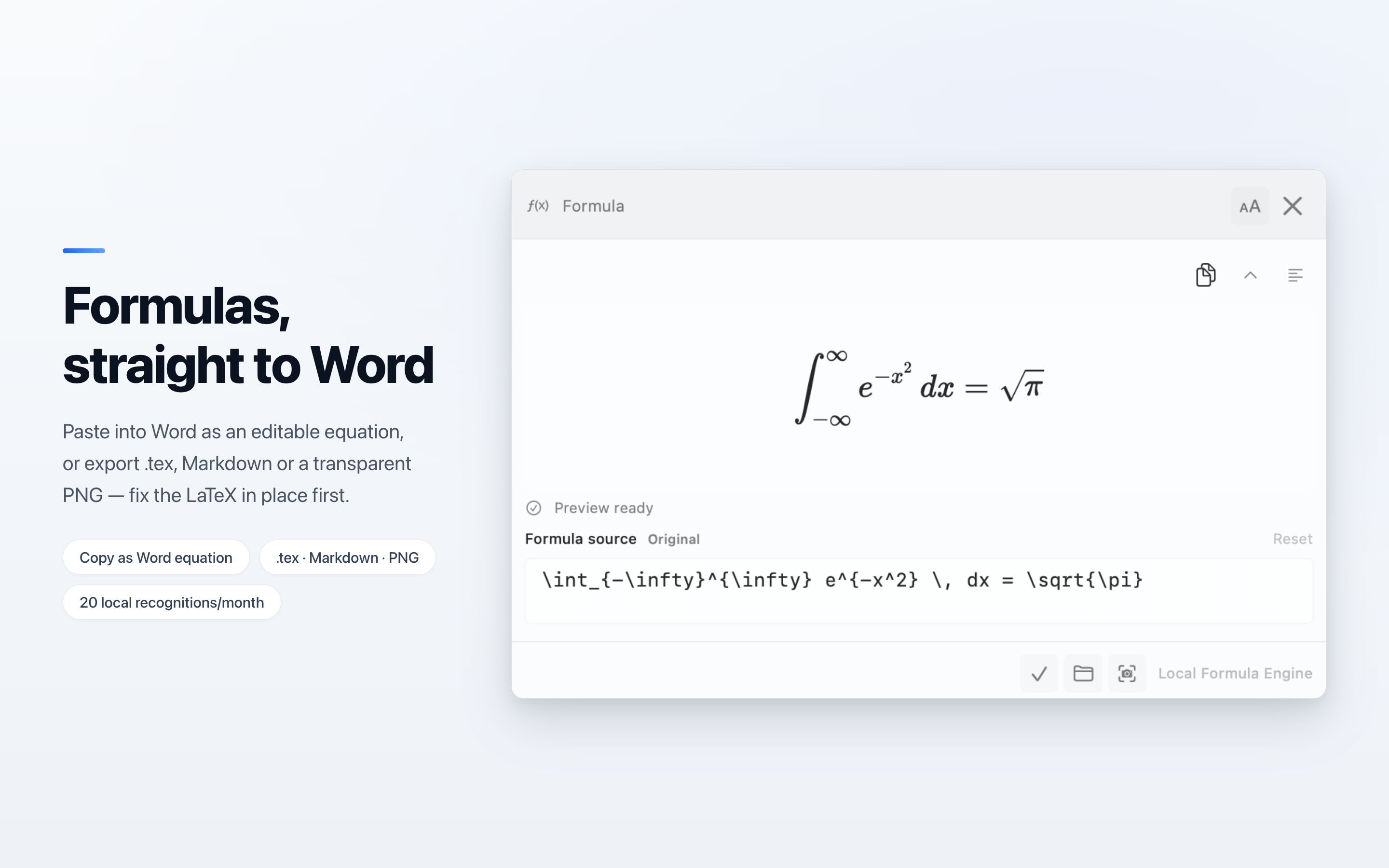
Workflow (screenshot to finished formula)
- Press
⌥Sand select a tight region around the printed formula. - In the result window, click Recognize formula.
- GLM-OCR processes the image on your Mac’s GPU via Metal (~2 seconds, 0 network requests).
- Check the KaTeX preview. If a symbol is wrong, click Show formula editor and fix the LaTeX source — the preview follows as you type.
- Open Copy or export formula: Copy as Word Equation for Word, raw or
$…$/$$…$$LaTeX for Overleaf and Markdown notes, or export a.tex/ Markdown fragment or a transparent PNG.
The entire pipeline — capture, recognition, correction, copy and export — stays on your Mac. Only the recognition itself counts toward the monthly allowance.
What is GLM-OCR
GLM-OCR is the on-device formula recognition engine bundled with ClariRec:
- Model: GLM-OCR, Q8_0 quantization; model weights under MIT license
- Size: two files, ~1.34 GB total (one-time download)
- Offline: works without network after download — no API key, no cloud account
- Rendering: LaTeX previewed locally with KaTeX; rendering itself never touches the network
- Memory management: unloads after 5 minutes idle, or earlier under system memory pressure
Requirements
| Requirement | Detail |
|---|---|
| Chip | Apple silicon (M1 or later) |
| Memory | 16 GB or more |
| macOS | 14 or later |
| Purchase | None — 20 free recognitions a month; Pro removes the limit |
Why Apple silicon + 16 GB
The local engine runs on the GPU of Apple silicon Macs through Metal. On Intel Macs or machines with less than 16 GB of memory, recognition would fall back to CPU-only processing — around 15 seconds per formula instead of ~2 seconds, with the model at risk of being evicted mid-run. On those Macs the local engine’s panel explains which requirement isn’t met and download is disabled.
You can still use formula recognition there via a BYOK cloud provider — any Mac running ClariRec Pro with a configured API key.
Download and setup
- Open Settings → Providers, then choose the Formula segment.
- Click Local Formula Engine in the list.
- Click Download Model. Both files show their own progress.
- Wait for the download to finish. It resumes where it stopped and verifies integrity with SHA-256 checksums.
- When both files are ready, the engine works offline.
In automatic mode a downloaded local model is used first; pick a cloud provider under Formula provider to use it instead. The model can be deleted from the same panel.
China mainland App Store accounts download from a ModelScope mirror for speed. If the mirror fails, ClariRec falls back to Hugging Face.
Want to see the result view before downloading anything? Settings → Providers → Formula → Formula examples opens five built-in formulas on any Mac.
Privacy boundary
| Item | Local (GLM-OCR) |
|---|---|
| When data leaves your Mac | Never (after the one-time model download) |
| Where it goes | Nowhere |
| LaTeX rendering, editing, copy and export | On your Mac — no network |
| ClariRec servers | None — ClariRec does not operate servers that receive your content |
| API cost | None |
Your screenshot never leaves the device. The monthly allowance is counted in your Mac’s Keychain as a month and a number — no images, formulas or device identifiers. No telemetry, no analytics SDK. See Local OCR for macOS for the full privacy and network boundary table.
Switching to a cloud provider
If you want to try a different model, or your Mac doesn’t meet the hardware requirement, you can switch to a BYOK cloud provider:
- Supported providers: Custom Vision API / Custom API, Qwen (通义千问)
- What changes: the screenshot is sent to your configured endpoint; you pay that provider; Pro is required
- What stays the same: preview, correction, copy and export still happen locally; ClariRec still doesn’t relay through its own servers
Choose the provider under Formula provider in Settings → Providers → Formula. Details: Screenshot to LaTeX — Cloud engine.
Tips for better results
- Crop tightly around the formula — avoid unrelated paragraph text in the same selection
- Prefer clear, high-contrast printed formulas over blurry photos
- Large images (above ~2560×1440) are automatically downscaled
- For a small slip, fix it in the formula editor; for a badly wrong result, adjust the selection and recognize again
Troubleshooting
The local engine won’t download The panel says why: it needs Apple silicon and 16 GB of memory. Use a BYOK cloud provider on other Macs.
Download stalls or fails Check your network. The download resumes where it stopped. China mainland App Store accounts should see the ModelScope mirror; if both sources fail, try again later.
Recognition is slow Normal speed on Apple silicon is ~2 seconds. Right after launch, or after the model was unloaded while idle, the first recognition also loads the model and takes a few seconds longer.
LaTeX is incomplete or wrong Fix small errors in the formula editor. If the result is far off, retake a tighter screenshot, or compare with a BYOK cloud provider.
The allowance ran out The 20 recognitions reset at the start of the next calendar month (UTC). Formulas you already recognized stay editable and exportable; Pro removes the limit.
You only needed plain text Formula recognition is a separate action — it does not interfere with normal System OCR, which stays free and local by default.
Related
Screenshot to LaTeX (full guide) · Local OCR · Offline checklist · API keys · FAQ